

Why the Toyota Supra MK4 Became a Cultural Icon | Zum Speed
The Toyota Supra MK4 became a cultural icon because it combined a genuinely overbuilt engine with perfect timing at the movies and in gaming, at the exact moment JDM culture was breaking into the mainstream. The 2JZ-GTE engine could handle far more power than Toyota ever intended, Fast & Furious put an orange MK4 at the center of the franchise that introduced import culture to millions of people, and Gran Turismo let an entire generation drive one before most of them could legally drive at all. Engineering built the foundation. Pop culture built the legend.
In this article
- The Engine That Started the Obsession
- Fast and Furious and the Orange Supra Effect
- Gran Turismo and a Generation That Grew Up With It
- Why Toyota Killed It, Then Brought It Back
- Engine, Movie, Game: Why That Combination Made an Icon
- FAQ
The Engine That Started the Obsession
The fourth-generation Supra, sold from 1993 through 2002 depending on the market, launched with the 2JZ-GTE, a twin-turbo 3.0 liter inline-six that Toyota rated around 320 horsepower in US trim. What made the 2JZ legendary wasn't its factory output. It was how much more the block could handle with the internals left completely stock. Tuners routinely pushed 2JZ-powered Supras past 700, 800, even 1,000 horsepower on the stock bottom end, something almost no other production engine of that era could survive.
That overbuilt reputation turned the Supra into a favorite among drag racers, drift builds, and street tuners who wanted massive power without the risk of blowing up the motor. Pair that with a proper 6-speed manual and a chassis that could handle the power, and the MK4 earned its spot among the platforms that actually deserved the hype, not just cars riding on marketing.

Fast and Furious and the Orange Supra Effect
In 2001, Brian O'Conner's orange MK4 Supra became one of the most recognizable cars in the original Fast & Furious, and arguably the single car most responsible for introducing import tuner culture to a mainstream American audience. Before that movie, JDM platforms were mostly known within a dedicated enthusiast community. After it, an entire generation of teenagers who had never heard of a touge or a 2JZ suddenly wanted an orange Supra of their own.
The Supra wasn't cast by accident. Production teams needed a car that photographed well, sounded aggressive with a turbo whistle, and had real credibility with the tuner community the film was trying to represent. The MK4 checked every box, and the movie's success cemented it as the face of an entire genre.
Gran Turismo and a Generation That Grew Up With It
Alongside the movies, Gran Turismo put the Supra in front of millions of players who could tune, drive, and race one long before owning a real one was realistic. For a lot of enthusiasts, their first real understanding of turbo lag, boost, and drivetrain layout came from grinding laps in a virtual MK4, not from a garage.
That matters because it built familiarity and loyalty at scale. A movie can make a car famous for a weekend. A game people replay for years builds a relationship with that car that lasts into adulthood, right around the time those same players finally have the income to go shopping for the real thing.
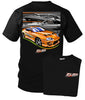
Front and back print, designed and printed in the USA. For the 2JZ faithful.
Why Toyota Killed It, Then Brought It Back
Toyota discontinued the Supra in the US after 1998 and in Japan by 2002, as the sports car market cooled, emissions regulations tightened, and insurance costs for high-powered coupes climbed. For 17 years, the MK4 wasn't just an icon, it was the only Supra, which only deepened its mythology as enthusiasts kept the platform alive through tuning culture while Toyota built nothing to replace it.
When Toyota finally revived the nameplate in 2019 with the GR Supra, built in partnership with BMW and sharing a platform with the Z4, the reaction from purists was mixed. Some welcomed a new Supra existing at all. Others argued a shared-platform car built with BMW parts couldn't carry the same weight as the original. That debate itself is proof of how much cultural ownership enthusiasts feel over the MK4 specifically.
Engine, Movie, Game: Why That Combination Made an Icon
Plenty of cars have one of these three ingredients. A handful of cars have two. The MK4 Supra is one of the rare platforms that had all three at once: an engine tuners genuinely respected, a movie that introduced it to the mainstream, and a game that let a whole generation grow up inside it before they could drive. Strip out any one piece and the Supra is probably still a well-regarded JDM sports car. With all three, it became something bigger than a car, which is exactly why people still argue about the GR Supra decades later.
Frequently asked questions
Why is the 2JZ engine so famous?
The 2JZ-GTE was built with an unusually strong iron block that could handle turbo upgrades and dramatically higher boost levels while keeping the factory internals intact. That reliability at high horsepower is rare for a factory engine and is the main reason it became a favorite among tuners.
Was the orange Supra in Fast and Furious a real MK4?
Yes, the film used real Toyota Supra MK4s modified for the production, and the orange car driven by Paul Walker's character became one of the most recognizable vehicles in tuner car culture as a direct result of the movie's popularity.
Why did Toyota stop making the Supra for so long?
Toyota discontinued the MK4 as sports car sales slowed industry-wide and emissions and insurance costs rose for high-performance coupes. The nameplate stayed dormant for 17 years until the GR Supra launched in 2019.
Is the new GR Supra considered a real Supra by enthusiasts?
Opinions are genuinely split. The GR Supra shares its platform and some components with the BMW Z4, which some purists feel disqualifies it from carrying the Supra name the same way the MK4 did, while others see it as a welcome continuation of the nameplate regardless of shared parts.
How much horsepower can a stock-internal 2JZ handle?
Many 2JZ-GTE engines have reliably handled 700 to 800 horsepower on the stock bottom end with supporting modifications, and some tuned examples have exceeded 1,000 horsepower, though results vary depending on the individual engine and how it's built and maintained.
Rep the Legend
Over 1,600 JDM and tuner enthusiasts trust Zum Speed. Designed and printed in the USA.
Shop Supra Shirts →Free shipping on all orders. Free size exchanges if it doesn't fit right.